The Ultimate Guide to Customer Interaction: Strategies, Best Practices & AI Tools

The Ultimate Guide to Customer Interaction: Strategies, Best Practices & AI Tools


What separates businesses that thrive from those that merely survive? The answer often lies in how they handle customer interaction every conversation, every touchpoint, every moment of engagement that shapes how customers perceive your brand.
Consider this: 89% of consumers have switched to a competitor following a poor customer experience, according to Salesforce research. Yet companies that excel at customer interaction see 60% higher profits than their competitors, as reported by Industry experts. The stakes have never been higher.
Customer interaction includes every communication and engagement between your business and its customers throughout the entire customer journey. From the first marketing touchpoint to post-purchase support, from handling complaints to nurturing loyalty, each customer interaction is an opportunity to strengthen or weaken your relationship with customers. A solid customer interaction strategy ensures your support team and support agents are equipped to meet customer expectations at every stage.
What is Customer Interaction?
Customer interaction refers to all forms of communication and engagement between a customer and a business throughout the customer journey. This includes every touchpoint where customers connect with your brand, whether through sales conversations, marketing campaigns, customer support, complaint resolution, or re-engagement efforts.
Unlike customer service, which focuses specifically on helping customers solve problems, customer interaction covers the broader spectrum of all customer communication. Every email opened, every chat initiated, every phone call answered, and every social media comment responded to constitutes a customer interaction. Effective customer interaction management helps organizations track and optimize these touchpoints across all communication channels.
Customer Interaction vs. Customer Experience
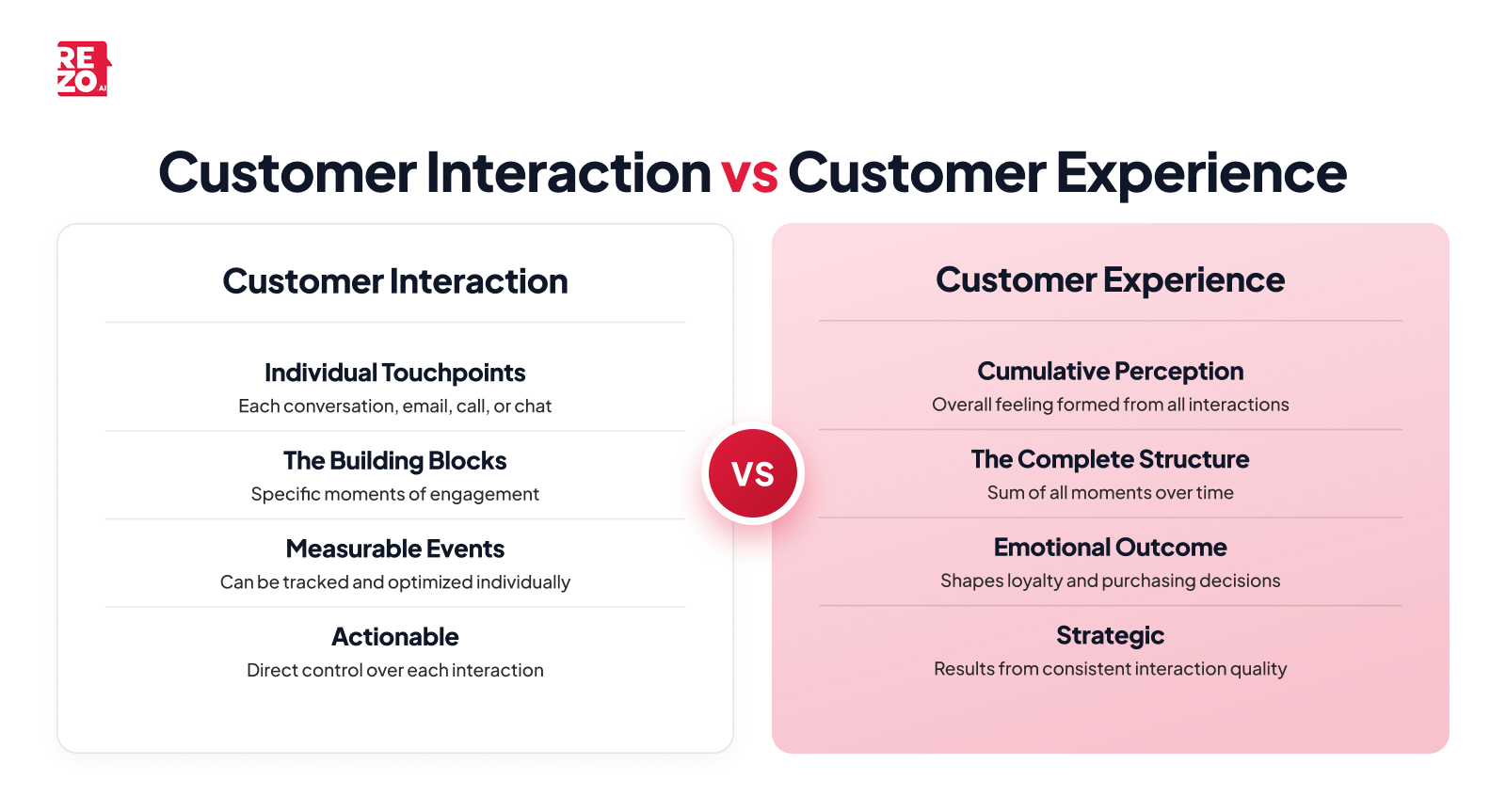
While often used interchangeably, these terms represent different concepts:
- Customer Interaction: The individual touchpoints and communications between customer and business
- Customer Experience (CX): The cumulative perception formed from all interactions over time
Think of customer interactions as the building blocks and customer experience as the complete structure they create. Each positive customer interaction adds to a favorable customer experience, while negative service interactions can quickly erode trust and loyalty.
According to PwC research, 73% of consumers say customer experience is a key factor in their purchasing decisions, making every customer interaction critically important.
Why Customer Interaction Matters
Effective customer interaction isn’t just good practice it’s a business imperative with measurable impact on your bottom line. Here’s why prioritizing customer interactions should be at the core of your customer interaction strategy:
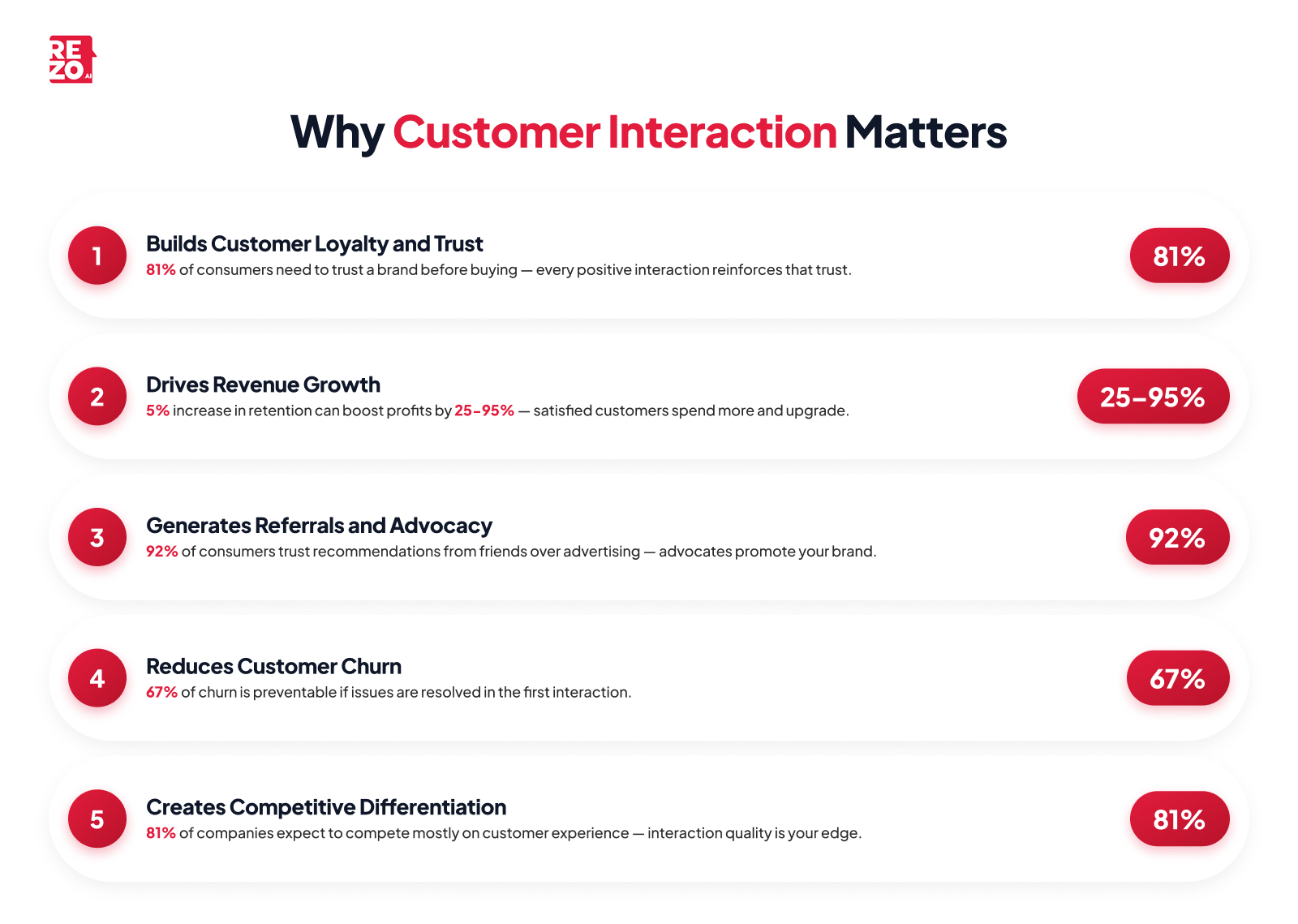
1. Builds Customer Loyalty and Trust
Trust is the foundation of lasting customer relationships. When customers feel heard, valued, and understood during their interactions with your business, they develop emotional connections that transcend transactional relationships.
Research shows that 81% of consumers need to trust a brand before they’ll buy from it. Every positive customer interaction reinforces that trust, while negative experiences can destroy years of relationship-building in moments. This is why gathering feedback consistently helps you understand customer pain points and address customer concerns before they escalate.
2. Drives Revenue Growth
Satisfied customers spend more. According to Harvard Business Review, increasing customer retention rates by just 5% can increase profits by 25% to 95%. Customers who have good customer interactions are more likely to:
- Make repeat purchases
- Upgrade to premium offerings
- Try new products and services
- Accept price increases more readily
Happy customers become loyal customers who expand your customer base through referrals and repeat business.
3. Generates Referrals and Brand Advocacy
Word-of-mouth remains one of the most powerful marketing forces. Nielsen research indicates that 92% of consumers trust recommendations from friends and family over any form of advertising.
When customers have exceptional interactions, they become advocates who actively promote your brand essentially becoming an unpaid extension of your marketing team. These loyal customers help you acquire new customers organically while building a loyal customer base.
4. Reduces Customer Churn
Poor customer interactions are the leading cause of churn. Another study found that 67% of customer churn is preventable if the customer’s issue is resolved during the first interaction.
By prioritizing quality customer interactions, you address customer concerns before they escalate, resolve customer issues efficiently, and give existing customers reasons to stay rather than leave. Your support team plays a critical role in turning unhappy customers into happy customers through effective customer service interactions.
5. Creates Competitive Differentiation
In markets where products and prices are increasingly similar, customer interaction quality becomes a key differentiator. Gartner research reveals that 81% of companies expect to compete mostly or completely on the basis of customer experience.
A well-executed customer interaction strategy combined with robust customer interaction management creates the foundation for a successful business.
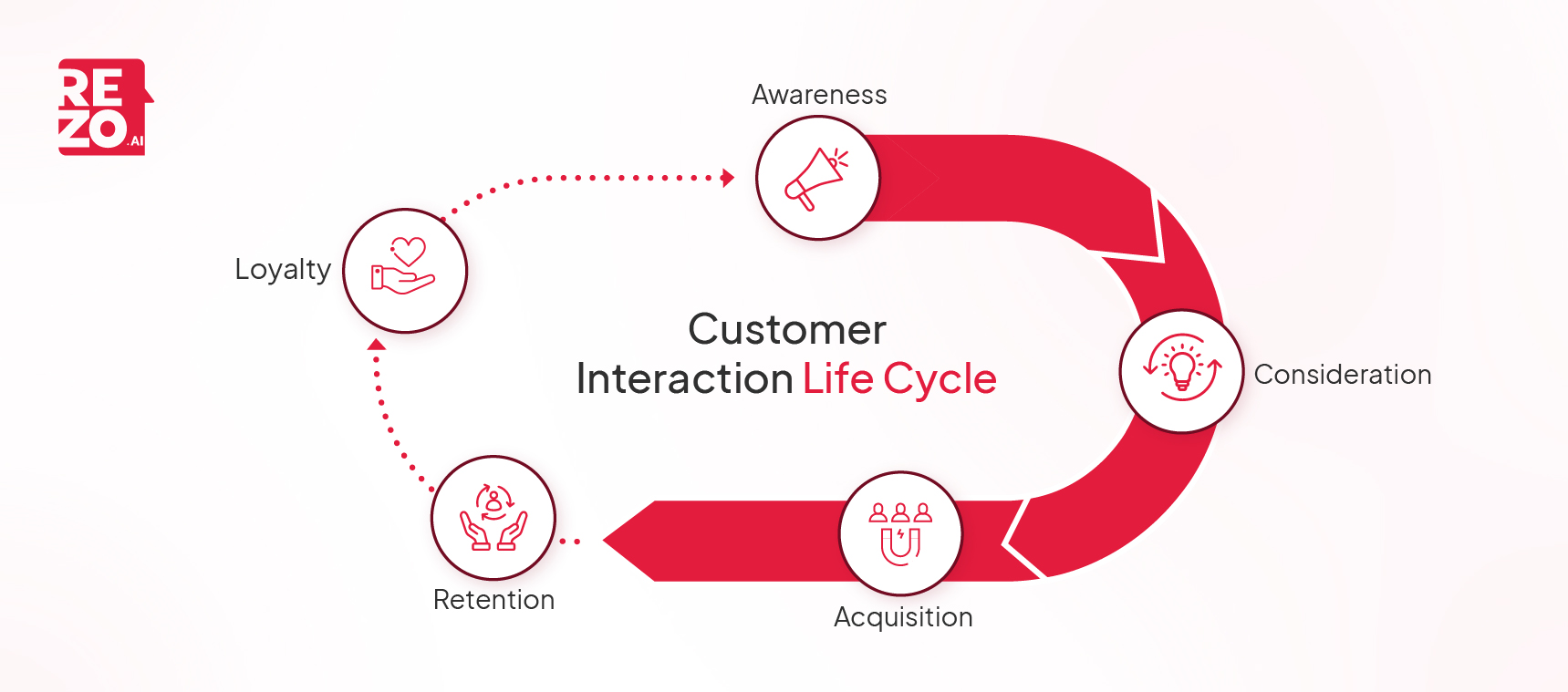
Each stage of the customer interaction cycle presents unique opportunities to strengthen customer relationships and meet customer needs.
Stage 1: Awareness
The awareness stage marks the customer’s first interaction with your brand. This could occur through:
- Social media content, advertisements, or social media posts
- Search engine results
- Word-of-mouth recommendations
- Industry events or publications
- Content marketing (blogs, videos, podcasts)
Best Practice: Focus on providing value rather than selling. Educational content, thought leadership, and relevant resources create positive first impressions that set the tone for future customer interactions.
Stage 2: Consideration
During consideration, potential customers actively evaluate your offerings against alternatives. Customer interactions at this stage include:
- Product demos and trials
- Sales conversations and phone calls
- Detailed content consumption (case studies, comparisons)
- Pricing discussions
- Q&A sessions where you answer customer questions
Best Practice: Be consultative rather than pushy. Understand customer needs and demonstrate how your solution addresses their unique challenges. Salesforce reports that 66% of customers expect companies to understand their needs and customer expectations.
Stage 3: Acquisition (Conversion)
The acquisition stage is where potential customers become new customers. Key customer interactions include:
- Purchase transactions
- Onboarding processes
- Welcome communications
- Initial setup support from your support team
- Contract or agreement signing
Best Practice: Make the buying process frictionless and celebrate new customers. A smooth onboarding experience reduces early churn and sets customer expectations for the relationship ahead.
Stage 4: Retention
Retention focuses on keeping customers engaged and satisfied post-purchase. This stage of the customer interaction cycle includes:
- Ongoing customer support through multiple communication channels
- Product updates and training
- Regular check-ins and account reviews
- Issue resolution by support agents
- Customer feedback collection through customer surveys
Best Practice: Be proactive rather than reactive. Don’t wait for customers to come to you with problems. Regular outreach demonstrates that you value the relationship beyond the initial sale. Gathering feedback helps you understand customer behavior and customer sentiment.
Stage 5: Loyalty and Advocacy
The ultimate goal is transforming satisfied customers into loyal customers and advocates. Customer interactions at this stage include:
- Loyalty program engagement
- Referral program participation
- Customer success stories and testimonials
- Community participation
- Beta testing new features
Best Practice: Recognize and reward loyalty. Create exclusive experiences for long-term customers and make it easy for them to share their positive experiences with others. Loyal customers become the foundation of your customer base.
Types of Customer Interactions
Not all customer interactions are created equal. Understanding the different types helps you prepare appropriate responses and allocate resources effectively across your customer interaction channels.
By Nature of Communication
- Inquiries - General customer questions about products, services, pricing, or company information. These represent opportunities to educate and build trust.
- Support Requests - Customers seeking help with issues, problems, or technical difficulties. Speed and effectiveness of resolution directly impact customer satisfaction scores.
- Complaints - Expressions of dissatisfaction that require careful handling. According to an industry report, only 1 in 26 unhappy customers complain, the rest simply leave. Each complaint is an opportunity to recover and improve through direct communication.
- Customer Feedback and Suggestions - Customers offering opinions, ideas, or recommendations. This valuable input drives product improvement and shows customers their voice matters.
- Compliments and Praise - Positive feedback that should be acknowledged, shared internally, and leveraged for testimonials.
By Channel
Human-to-Human Interactions:
- Phone calls (direct interactions with support agents)
- In-person meetings
- Video conferences
- Live chat with customer support agents
Automated/AI-Assisted Interactions:
- AI-powered chatbots that handle customer queries
- Automated email sequences
- Self service options and portals
- Interactive voice response (IVR) systems
Gartner predicts that by 2027, chatbots will become the primary customer service channel for approximately 25% of organizations highlighting the growing importance of automated customer interactions across customer interaction channels.
By Urgency Level
Stabilizing Interactions: Routine communications that maintain the relationship (newsletters, check-ins, updates)
Critical Interactions: Time-sensitive customer issues requiring immediate attention (outages, urgent complaints, time-bound requests)
Planned Interactions: Scheduled engagements (quarterly reviews, renewal discussions, training sessions)
Best Practices for Effective Customer Interaction
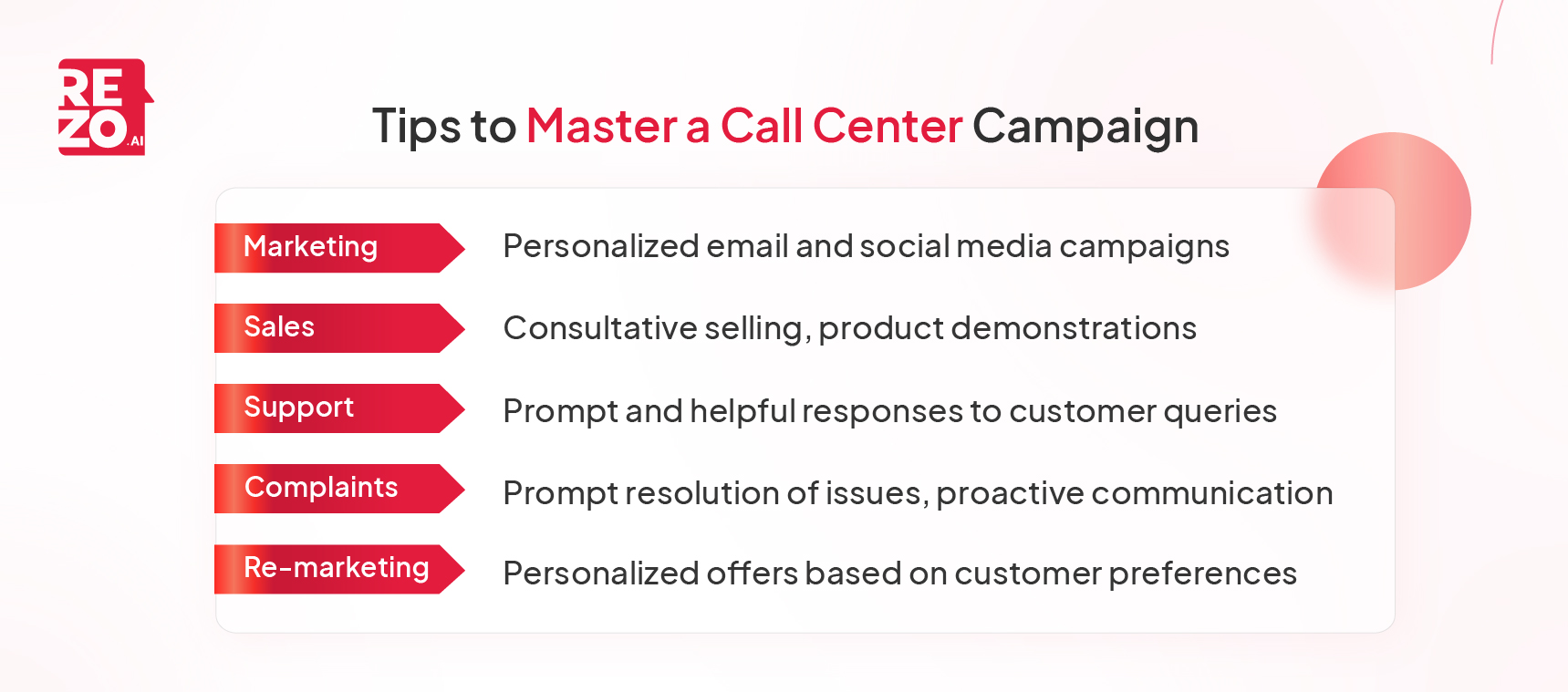
Implementing these proven strategies will transform your customer interactions from transactional exchanges into relationship-building opportunities. A strong customer interaction strategy incorporates these best practices across all customer service interactions.
1. Lead with Empathy and Genuine Care
Customers can tell when interactions feel scripted versus genuine. Train your support team and customer service team to:
- Acknowledge emotions before solving problems
- Use the customer’s name naturally in conversation
- Express genuine appreciation for their business
- Show understanding of their frustration when customer issues arise
A study by Businessolver found that 93% of employees are more likely to stay with an empathetic employer—and this empathy translates directly to how your customer service team treats customers.
2. Anticipate Needs Proactively
Don’t wait for customers to reach out with problems. Proactive engagement by your support team includes:
- Sending usage tips before customers struggle
- Alerting customers to potential issues before they occur
- Recommending relevant products based on customer’s purchase history
- Following up after purchases to ensure customer satisfaction
Research shows that proactive customer service can reduce call volumes by up to 30% while increasing customer satisfaction scores. This approach helps you understand customer behavior and understand customer pain points before they become complaints.
3. Communicate with Transparency
Honesty builds trust, even when the news isn’t good. Direct communication includes:
- Set realistic customer expectations about timelines and outcomes
- Admit mistakes quickly and explain how you’ll fix them
- Be upfront about limitations or constraints
- Share relevant resources customers need to make decisions

4. Actively Solicit and Act on Customer Feedback
Create multiple channels for gathering feedback:
- Post-interaction customer surveys (keep them brief)
- Net Promoter Score (NPS) tracking
- Customer advisory boards
- Social media monitoring
- Direct outreach for candid conversations
Critically, close the feedback loop by communicating what actions you’ve taken based on customer feedback. This shows you understand customer concerns. Learn more about measuring satisfaction in our guide on what is CSAT and how to improve it.
5. Personalize Every Customer Interaction
McKinsey research indicates that 71% of consumers expect personalized customer interactions, and 76% get frustrated when this doesn’t happen.
Personalization strategies for personalized support include:
- Referencing past interactions and purchases
- Using customer data to tailor recommendations based on customer’s purchase history
- Adjusting communication style to customer preferences
- Recognizing milestones and anniversaries
6. Meet Customers on Their Preferred Channels
Omnichannel customer support isn’t optional anymore, customers expect it. They want to engage through multiple communication channels:
- Email for detailed, non-urgent matters
- Phone calls for complex or emotional customer issues
- Chat for quick customer question.
- Social media and social media posts for public engagement.
- Self service options for simple tasks.
Ensure consistent service quality across all customer interaction channels and enable seamless transitions between them.
7. Resolve Issues on First Contact
First-contact resolution (FCR) is a critical customer interaction metric. SQM Group research shows that for every 1% improvement in FCR, you see a 1% improvement in customer satisfaction.
To improve FCR, support operations should:
- Empower support agents with decision-making authority
- Provide comprehensive knowledge bases to answer customer questions
- Use AI-powered agent assist tools for real-time information access
- Reduce transfers and escalations
8. Reward Customer Loyalty
Recognition reinforces positive behavior and creates loyal customers:
- Implement tiered loyalty programs
- Offer exclusive access or early releases to long-term customers
- Provide unexpected perks and surprises
- Celebrate customer milestones publicly (with permission)
The Role of AI in Modern Customer Interaction
Artificial intelligence is revolutionizing how businesses manage customer interactions, not by replacing human connection, but by enhancing it. Understanding how to leverage AI in customer service operations is crucial for staying competitive in 2025 and beyond.
How AI Transforms Customer Interactions
- 24/7 Availability - AI-powered chatbots and virtual assistants handle customer inquiries around the clock, ensuring no customer waits for business hours to get help. This is particularly valuable for global businesses serving multiple time zones.
- Instant Response Times - While agents juggle multiple conversations, AI can respond instantly to thousands of simultaneous customer queries without degradation in service quality.
- Consistent Quality - AI delivers consistent responses based on trained knowledge bases, eliminating variability in service quality that comes with different support agents.
- Intelligent Routing - AI analyzes incoming customer queries and routes them to the most appropriate resource—whether that’s an automated response, a specific department, or a particular agent with relevant expertise.
- Predictive Support - Advanced AI systems can predict customer needs and customer issues before they arise, enabling predictive customer support that addresses customer pain points proactively.
AI-Powered Customer Interaction Tools
Modern AI platforms offer sophisticated capabilities for customer interaction management:
- Conversational AI - Natural language processing enables AI to understand customer intent and respond conversationally. Unlike rigid chatbots of the past, today’s conversational AI handles complex customer queries with nuance and context awareness, understanding customer behavior patterns.
- Speech Analytics - AI-powered speech analytics analyzes voice interactions from phone calls to identify customer sentiment, detect issues, and uncover coaching opportunities, transforming every call into actionable data.
- Agent Assist Technology - AI doesn’t replace agents, it empowers them. Agent assist tools provide real-time information, suggested responses, and next-best-action recommendations, helping customer support agents deliver faster, more accurate service while managing customer interactions effectively.
- Automated Quality Monitoring - AI can evaluate 100% of customer interactions against quality criteria, helping you monitor customer interactions and identify patterns and improvement opportunities that manual sampling would miss.
The Human-AI Balance
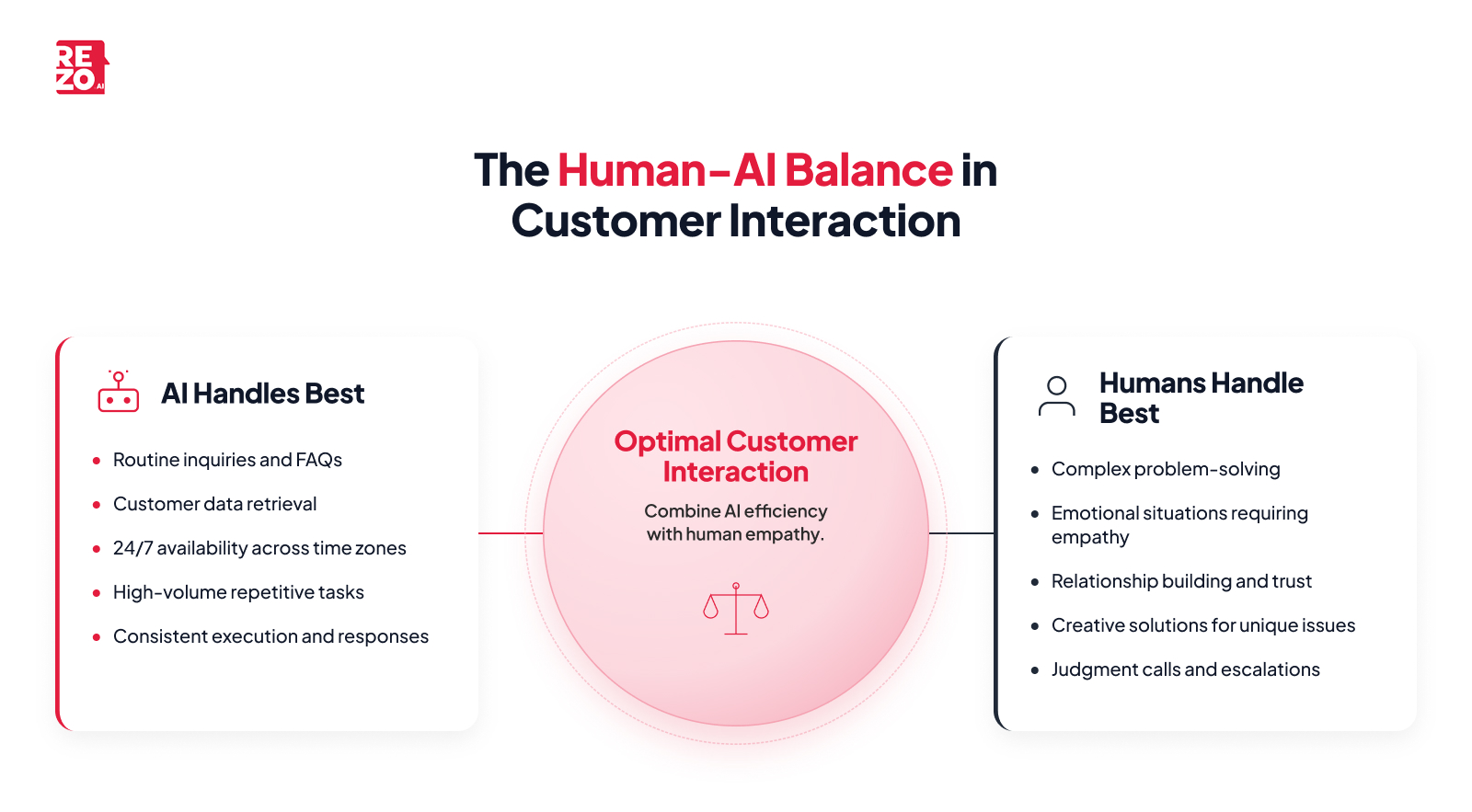
The most effective approach combines AI efficiency with human empathy. AI in customer service works best when properly balanced:
The goal isn’t to automate everything, it’s to automate what AI does better so your support team can focus on what they do better: building relationships with customers and handling complex customer issues.
Explore how AI is shaping customer journey automation in our detailed guide.
Customer Interaction Management: Tools and Technology
Effective customer interaction requires the right technology infrastructure. Customer interaction management (CIM) covers the tools and processes that help organizations manage customer interactions, track touchpoints, and optimize all customer communication across the customer journey.
Essential Customer Interaction Management Capabilities
- Unified Customer View - All interaction history, customer preferences, and customer data accessible in one place, enabling personalized customer interactions regardless of channel or agent.
- Omnichannel Management - Seamless integration across phone calls, email, chat, social media, and self service options.
- Analytics and Insights - Data-driven visibility into interaction patterns, customer satisfaction metrics, and improvement opportunities. Track customer interaction metrics to understand customer sentiment and customer behavior.
- Automation and AI - Intelligent automation through automating routine tasks and AI-assisted service delivery to enhance customer interactions.
- Quality Management - Tools to monitor customer interactions, evaluate service quality, and improve customer interaction quality consistently.
Evaluating Customer Interaction Management Platforms
When selecting customer interaction management technology, consider:
- Integration Capabilities: Does it connect with your existing systems (CRM, ERP, etc.)?
- Scalability: Can it grow with your customer base?
- AI and Automation: What intelligent capabilities does it offer?
- Analytics: How deep and actionable are the customer interaction metrics?
- User Experience: Is it intuitive for your customer service team to use?
- Customization: Can it adapt to your specific workflows and customer interaction strategy?
For a detailed comparison, see our guide to Top 5 CX Automation Platforms in 2025.
Measuring Customer Interaction Success
What gets measured gets improved. Track these key customer interaction metrics to evaluate and enhance customer interaction effectiveness:
Customer Satisfaction (CSAT)
Measures customer satisfaction with specific customer interactions. Typically captured through post-interaction customer surveys asking customers to rate their experience.
Target: 80%+ satisfaction rate
Net Promoter Score (NPS)
Measures overall customer loyalty by asking how likely customers are to recommend your business.
Target: 50+ is excellent; 70+ is world-class
First Contact Resolution (FCR)
Percentage of customer issues resolved in a single customer interaction.
Target: 70-75% for most industries
Average Handle Time (AHT)
Average duration of customer interactions. Balance efficiency with quality, shorter isn’t always better for complex customer service interactions.
Customer Effort Score (CES)
Measures how easy it was for customers to get their issues resolved. Lower effort correlates strongly with customer loyalty.
Response and Resolution Times
Track how quickly you respond to and resolve customer inquiries across all communication channels.
Conclusion: Transform Your Customer Interactions
Every customer interaction is an opportunity, to build trust, to solve problems, to create loyal customers, or to lose business forever. In an era where customer experience drives competitive advantage, mastering customer interaction isn’t optional; it’s essential.
The Path Forward
Start by auditing your current customer interaction touchpoints. Identify gaps, inconsistencies, and opportunities for improvement. Implement the best practices outlined in this guide incrementally, measuring impact as you go.
Consider how AI and automation can enhance customer interactions without sacrificing the human connection that builds lasting customer relationships. The most successful organizations in 2025 and beyond will be those that master this balance through effective customer interaction management and a clear customer interaction strategy.
Ready to transform your customer interactions? Schedule a consultation with Rezo.ai to learn how our platform helps you deliver exceptional customer interactions at scale turning every touchpoint into an opportunity to create happy customers and grow your customer base.
Frequently Asked Questions
What is the difference between customer interaction and customer service?
Customer service is a subset of customer interaction focused specifically on helping customers resolve issues or answer customer questions. Customer interaction covers all communications between customers and your business, including marketing, sales, support, and engagement activities across all customer interaction channels.
How can AI improve customer interactions?
AI enhances customer interactions by providing 24/7 availability, instant responses, consistent service quality, intelligent routing, and predictive support. It handles routine customer inquiries efficiently while freeing support agents to focus on complex issues requiring empathy and judgment.
What are the key stages of the customer interaction cycle?
The five stages of the customer interaction cycle are: Awareness (discovery), Consideration (evaluation), Acquisition (purchase), Retention (ongoing engagement), and Loyalty (advocacy). Each stage requires different customer interaction strategies.
How do you measure customer interaction effectiveness?
Key customer interaction metrics include Customer Satisfaction (CSAT), Net Promoter Score (NPS), First Contact Resolution (FCR), Customer Effort Score (CES), and response/resolution times. Track these metrics consistently to identify improvement opportunities in your customer interaction management.
What is customer interaction management (CIM)?
Customer interaction management refers to the tools, technologies, and processes organizations use to manage customer interactions, track touchpoints, and optimize all customer communication. It includes omnichannel communication platforms, analytics tools, automation capabilities, and quality management systems.
Frequently Asked Questions (FAQs)


Take the leap towards innovation with Rezo.ai
Get started now