How Conversational AI is Helping Brands in B2B Marketplace

How Conversational AI is Helping Brands in B2B Marketplace


Here is a reality that most B2B marketing teams quietly struggle with: your buyers are ready to talk, but nobody is there to answer. AI tools for B2B marketing are changing that, and the shift is happening faster than most sales teams realize.
Think about your own buying behavior. You expect instant answers. You want relevant recommendations. You do not want to fill out a form and wait 24 hours for a generic email. Your B2B buyers feel the same way. According to Salesforce, 79% of customers now expect consistent communication from brands, and that expectation does not pause just because it is a B2B transaction. The customer experience suffers every time a response is delayed.
The timing problem makes this even more urgent. Research shows that 37% of B2B sales transactions happen outside business hours. That means more than a third of your potential pipeline activity is occurring when your sales teams are offline. Leads go cold. Competitors respond first. Deals slip away from your pipeline before sales reps even get a chance to respond.
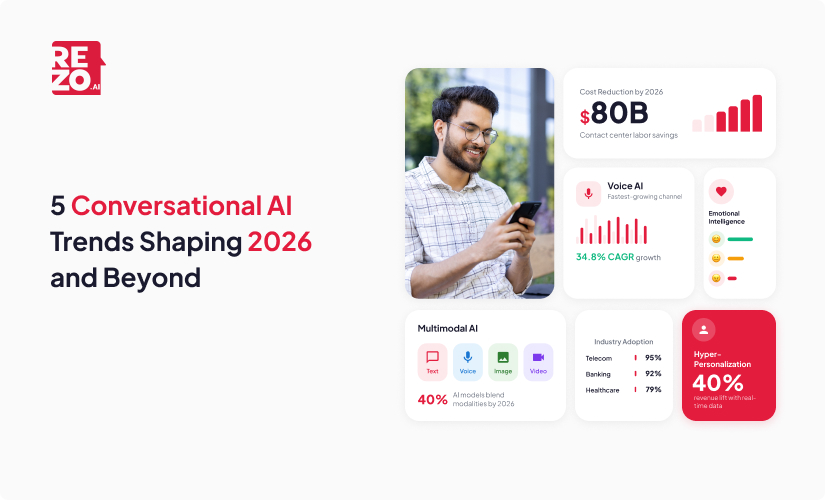
The scale of the opportunity is significant. Artificial intelligence is projected to reduce contact center agent labor costs by $80 billion in 2026, signaling that enterprise adoption of AI tools is no longer experimental. AI in B2B is now a core part of modern marketing strategies.
This guide is for B2B marketing leaders who want to move past basic chatbot experiments and use AI powered solutions strategically, across the entire process of the buyer journey.
What Is Conversational AI (and How Is It Different from Chatbots)?
Conversational AI is an umbrella term for AI technology that uses natural language processing (NLP), natural language understanding, large language models (LLMs), and machine learning to understand, interpret, and respond to human language in real time. Unlike rule-based chatbots that follow rigid scripts and decision trees, these platforms adapt to context, handle complex multi-turn conversations, and use machine learning to improve with every customer interaction.
In a B2B marketing context, this distinction is critical. Your buyers are not asking simple yes-or-no questions. They are evaluating solutions across multiple stakeholders, navigating long sales cycles, and raising nuanced objections that a scripted bot simply cannot handle. AI powered software meets that complexity head-on, with features intent recognition capabilities that understand buyer questions and search intent behind every message.
AI technology also operates across multiple channels. Whether your buyers prefer website chat, WhatsApp, voice, email, or SMS, artificial intelligence creates a consistent, omnichannel engagement experience across all marketing channels. The conversation picks up wherever the buyer left off, regardless of the channel, delivering personalized customer experiences at every touchpoint.
The market is moving fast. Research reveals that 89% of revenue organizations now use AI powered tools, up from just 34% in 2023. If your B2B marketing team has not explored AI in B2B yet, you are already behind the majority of your peers. Understanding the differences between AI agents and traditional chatbots is a good starting point for implementing AI into your sales process.
How AI Tools Transform B2B Marketing (6 Use Cases)
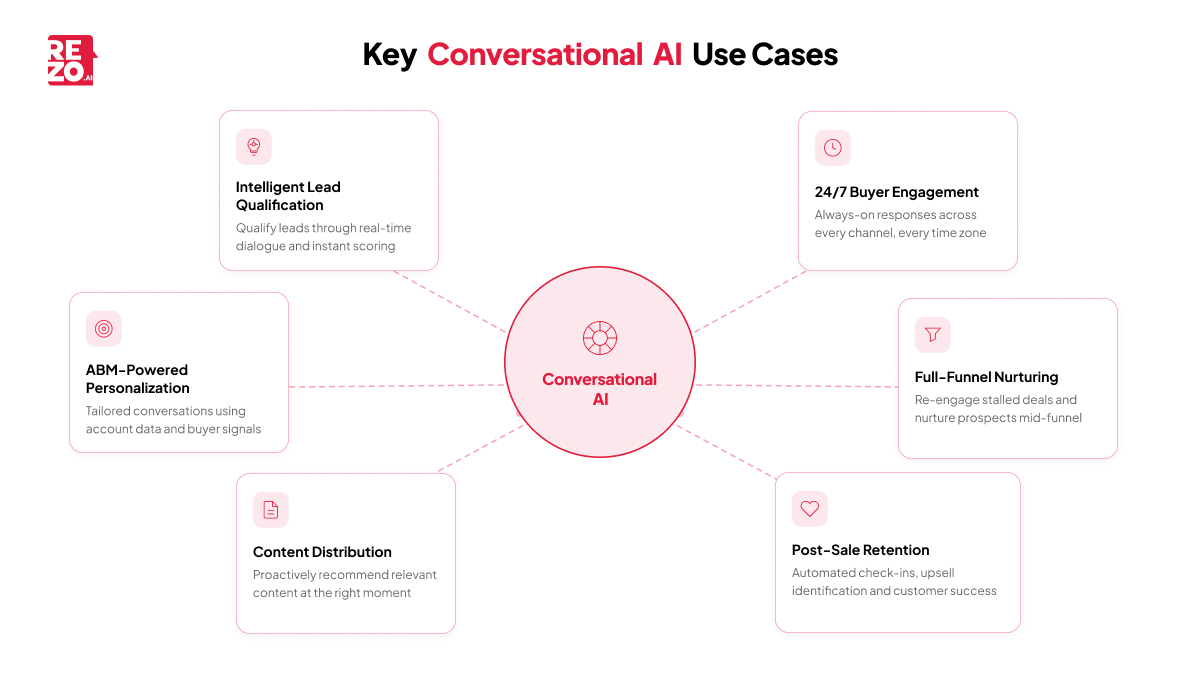
AI powered artificial intelligence solutions are not single-trick tools. When deployed thoughtfully, they create value across every stage of the B2B buyer journey. Here are six high-impact use cases that go well beyond basic lead capture and lead generation.
Intelligent Lead Qualification That Goes Beyond MQLs
Traditional lead qualification relies on form fills and content downloads, which tell you what a prospect did but not what they actually need. AI tools change the game by qualifying leads through real-time dialogue, analyzing customer data and customer behavior to determine genuine purchase intent.
This approach creates what industry analysts are calling Agent-Qualified Leads (AQLs). Instead of scoring leads based on static behavior, an AI assistant asks the right questions, evaluates intent data from responses, and routes high-value prospects to your sales teams instantly. By combining historical data with machine learning and predictive analytics, these AI powered platforms identify prospects most likely to convert.
24/7 Buyer Engagement Across Every Channel
Your sales teams work business hours. Your buyers do not. With B2B transactions now happening outside traditional working hours, always-on AI tools ensure that no high-intent website visitors leave your site without engagement.
This is not just about having a chat widget. It is about providing intelligent, contextual responses through AI software across web chat, WhatsApp, voice, and SMS at any hour. In competitive B2B deals, response time often determines who wins the account. AI powered solutions reduce that time from hours to seconds, giving your sales reps a decisive advantage. An AI assistant can automate customer interactions around the clock, capturing live engagement signals and intent data that sales teams use the next morning.
ABM-Powered Personalization at Scale
Account based marketing works best when every interaction feels tailored. AI tools make that possible at scale by pulling in firmographic data, company data, account history, and real-time browsing behavior to personalize dialogues on the fly.
Imagine a target account visiting your website. Instead of a generic greeting, the AI powered platform recognizes their company, references a relevant case study in their industry, and asks about their specific challenges using data analytics and customer data to tailor the entire process. AI powered ABM approaches drive 208% higher revenue growth compared to traditional methods, and artificial intelligence is a key enabler of that personalization. This is how AI in B2B transforms your marketing strategies from generic outreach into meaningful customer engagement.
Full-Funnel Nurturing (Not Just Lead Gen)
Most B2B marketing teams deploy AI tools only at the top of the sales funnel. That is a missed opportunity. The real power lies in mid-funnel nurturing: re-engaging stalled deals, sharing relevant content at the right moment, and addressing objections before they become deal-breakers. Predictive analytics powered by historical data help identify the right timing for each touchpoint in the customer journey.
For example, if a prospect downloads a whitepaper but does not book a demo, an AI assistant can trigger a contextual follow-up a few days later, asking if they have questions about the content creation piece. If someone revisits your pricing page or landing pages after weeks of silence, AI software can proactively engage with a tailored message based on their user behavior and customer behavior patterns.
Conversational Content Distribution
B2B companies invest heavily in content creation: case studies, whitepapers, reports, marketing materials, and webinars. But most of that content sits passively on your website, waiting for buyers to find it. AI driven platforms flip this model and transform the content creation process entirely.
Instead of relying on navigation menus and AI powered search bars, artificial intelligence proactively recommends the most relevant content based on where a buyer is in their customer journey. A first-time website visitor might receive an industry overview. A returning prospect who already attended a webinar might get a tailored case study. This turns your content library into an active experience that can generate content recommendations and social media posts for follow-up distribution across marketing channels. The ability to generate content suggestions dynamically means your sales reps always have the right marketing materials to share at the right time, powered by real time data and data points from every interaction.
Post-Sale Retention and Upselling
AI tools are not just an acquisition solution. After the deal closes, they can drive customer retention by proactively checking in, gathering user feedback, surfacing support resources, and identifying upsell opportunities based on usage patterns and customer data. Virtual assistants and AI assistants handle customer queries instantly, improving the overall customer experience.
Agentic AI is projected to autonomously resolve 80% of common customer service issues by 2029. For B2B companies, this means AI software can handle repetitive tasks and automate repetitive tasks in post-sale interactions, freeing your customer success team to focus on strategic relationship building and business growth.
This full-funnel approach is what separates teams that use AI in B2B strategically from those running one-off chatbot experiments.
Why Most B2B Teams Still Get AI in B2B Wrong
Adoption is surging, but execution is lagging. Salesforce's 10th State of Marketing report reveals a striking gap: 75% of marketers have adopted artificial intelligence, yet 84% still run generic outreach programs. Buying the tool is the easy part. Using AI tools well is where most sales teams stumble.
Here are the most common mistakes:
Treating AI software as "set and forget." AI powered platforms are not a light switch. They require ongoing training, prompt refinement, and performance monitoring using data analytics and performance reviews. The dialogues your AI assistant has today should be noticeably better than the ones it had three months ago. Generative AI capabilities should be updated regularly with fresh historical data to keep responses sharp.
Poor CRM integration. If your AI tools do not flow customer interactions into your CRM and marketing automation stack, you lose the data advantage entirely. Your AI technology becomes an expensive FAQ page that generates exchanges but no pipeline insights. CRM data must flow both ways, with integration capabilities that connect every data point from the sales process to your marketing campaigns.
Ignoring the human-AI handoff. In high-value B2B deals, buyers eventually need to speak with a real person. If there is no clear escalation protocol, you risk frustrating your best prospects at the worst possible moment. AI in B2B must complement your sales teams, not replace them.
Tracking the wrong metrics. Chat volume and bot interactions look impressive on a dashboard but tell you nothing about business impact. Pipeline contribution, deal velocity, and customer satisfaction are what matter for business success. Predictive analytics can help you measure the right data points.
The stakes are high. Forrester predicts that B2B companies will lose more than $10 billion from ungoverned generative AI use, reinforcing why strategic governance of AI in B2B is not optional. Deploying these tools without proper oversight is a risk to your entire business practices.

How to Implement AI Tools in Your B2B Marketing Strategy?
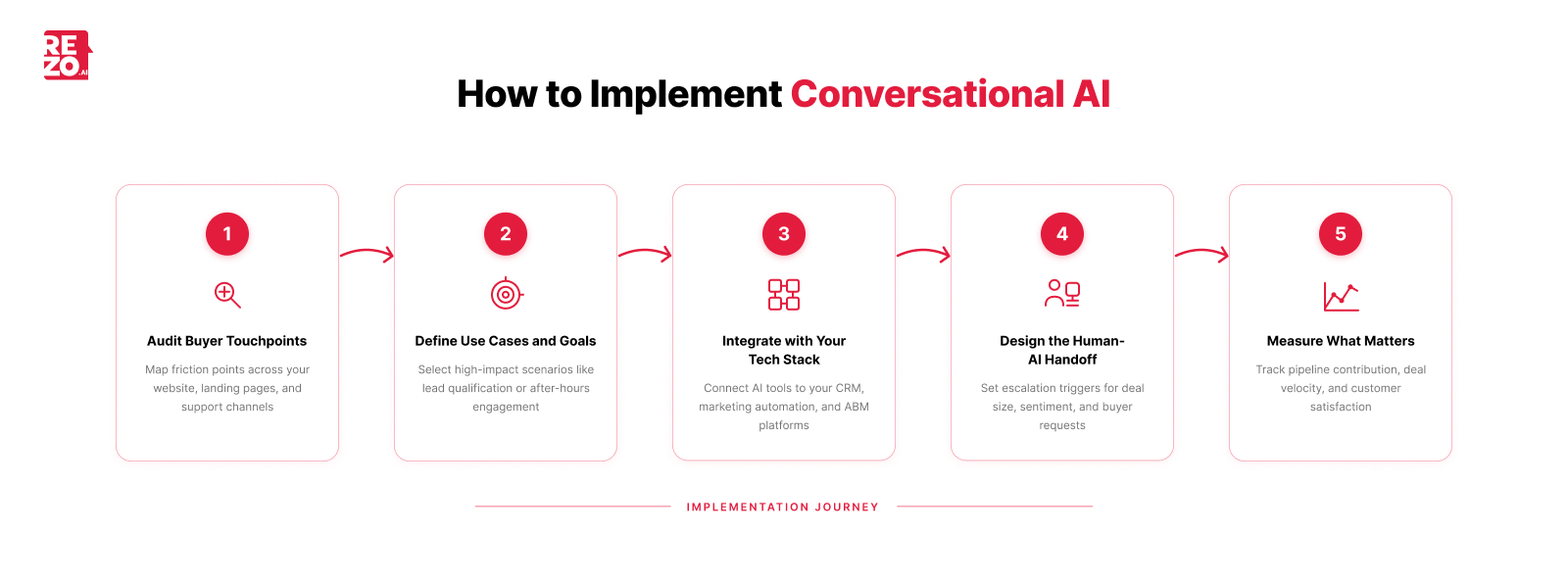
Moving from interest to implementing AI does not have to be overwhelming. Here is a practical five-step framework that B2B marketing and sales teams can follow.
Step 1. Audit Your Current Buyer Touchpoints
Start by mapping every point where buyers interact with your brand: website pages, landing pages, email sequences, social media posts, event marketing channels, and support portals. Identify where leads drop off or experience friction. Long response times, dead-end forms, and lack of personalization are common culprits. Use data analytics to analyze customer behavior and user behavior at each touchpoint. Prioritize high-traffic, high-intent landing pages and touchpoints for your first AI powered deployment to reach your target audience effectively.
Step 2. Define Your Use Cases and Goals
Do not try to automate repetitive tasks everywhere on day one. Pick one or two high-impact use cases to start. Lead qualification on your pricing page or after-hours buyer engagement are strong starting points for your sales process. Set measurable goals: lead-to-opportunity conversion rate, average response time, and pipeline contribution. Map these to your target audience and pipeline stages. Focus on the repetitive tasks that drain your sales reps' time and automate customer interactions where intelligent automation delivers the most value.
Step 3. Integrate with Your Existing Tech Stack
AI tools must plug into your CRM, marketing automation, and account based marketing platforms to deliver real value. CRM data needs to flow both ways. AI powered conversations should inform lead scoring, and customer data should personalize interactions through the user interface. Reports show that 73% of marketing teams already use generative AI, so integrating AI technology with your existing tech stack is not just important, it is non-negotiable for your marketing strategies. Look for AI software with strong integration capabilities that connect to your existing business processes.
Step 4. Design the Human-AI Handoff
Define clear escalation triggers. These might include deal size thresholds, negative sentiment signals, or explicit buyer requests for human agents. Train your sales reps to pick up discussions started by the AI assistant seamlessly, without making the buyer repeat themselves. In enterprise B2B marketing, where relationships drive decisions, this handoff experience can make or break a deal. A user friendly interface for your sales teams to review AI powered conversation history and real time data is essential for a smooth transition.
Step 5. Measure What Matters
Go beyond vanity metrics. Track deal velocity, pipeline contribution, customer satisfaction (CSAT), and time-to-first-response. Salesforce's State of Marketing report found that high performers using AI agents see a 20% average bump in results, but that performance comes from disciplined measurement and continuous optimization of your marketing campaigns. Review your AI tools performance monthly. Use predictive analytics and historical data to identify trends. The best AI in B2B strategies are always iterative, and business growth depends on refining your approach based on real time data.
What Is Next for AI in B2B Marketing?
The next evolution is already underway. Agentic AI, systems that do not just converse but take autonomous action, is poised to reshape B2B marketing. Think artificial intelligence that books meetings, updates CRM data, triggers nurture sequences, adjusts messaging strategy, and supports event marketing workflows without waiting for human instruction. Conversational AI agents and AI powered virtual assistants are already handling parts of this workflow. Companies already using agentic AI for customer journey automation are seeing this shift firsthand.
Research predicts that 60% of brands will use agentic AI for streamlined one-to-one engagements by 2028. Meanwhile, 91% of customer service leaders already feel pressure to implement these solutions in 2026, and B2B marketing leaders are right behind them. By 2026, 80% of advanced marketing and sales teams are expected to use generative AI and AI powered tools to optimize multichannel marketing campaigns in real time.
AI in B2B is no longer a nice-to-have experiment. It is becoming foundational infrastructure for B2B marketing and customer engagement. AI tools and artificial intelligence platforms are transforming business practices across every industry. The teams that build on it now will have a compounding advantage over those that wait, driving business growth and lasting competitive advantage for years to come.
Final Thoughts
Conversational AI for B2B marketing is not about replacing your team. It is about giving every team member, from sales reps to marketing strategists, the ability to engage every buyer, at every stage of the customer journey, without dropping the ball.
The evidence is clear. Companies that implement AI tools strategically see better-qualified leads, faster pipeline movement through the pipeline, and stronger customer relationships. The gap between AI adopters and AI leaders is widening every quarter, and implementing AI effectively is now essential for business success.
The question is no longer whether to adopt artificial intelligence. It is how quickly you can implement AI powered solutions well.
Start with one use case. Measure relentlessly. Scale what works. That is how the best B2B marketing teams are turning customer conversations into pipeline and driving lead generation through intelligent content creation and customer engagement.
Frequently Asked Questions
What is the difference between conversational marketing and conversational AI?
Conversational marketing is a strategy focused on engaging buyers through real-time, personalized dialogue across the sales funnel. The underlying AI technology is powered by natural language processing and machine learning, that enables those intelligent customer interactions at scale. Together, they automate repetitive tasks and transform how sales teams manage the entire sales process.
Can AI tools replace human sales reps in B2B?
No, and they should not. AI powered solutions handle routine qualification, initial customer engagement, and repetitive tasks like follow-ups and answering customer queries, freeing your sales reps to focus on high-value relationship building and complex negotiations. The goal of AI in B2B is to augment your sales teams, not replace them.
How long does it take to implement AI tools for B2B marketing?
Most mid-market companies can deploy a first use case in four to eight weeks, including AI software setup, CRM data integration, and initial conversation design with your tech stack. Expansion into additional lead generation, content creation, and marketing campaigns typically follows over three to six months as your target audience data and predictive analytics capabilities mature.
Frequently Asked Questions (FAQs)


Take the leap towards innovation with Rezo.ai
Get started now